Part 1. First Mausoleum, then Castle
Few Roman monuments have a history as complex and fascinating as that of Castel Sant'Angelo, which is inextricably intertwined with that of Rome, the Roman Empire, and then the Papacy.
The Mausoleum.
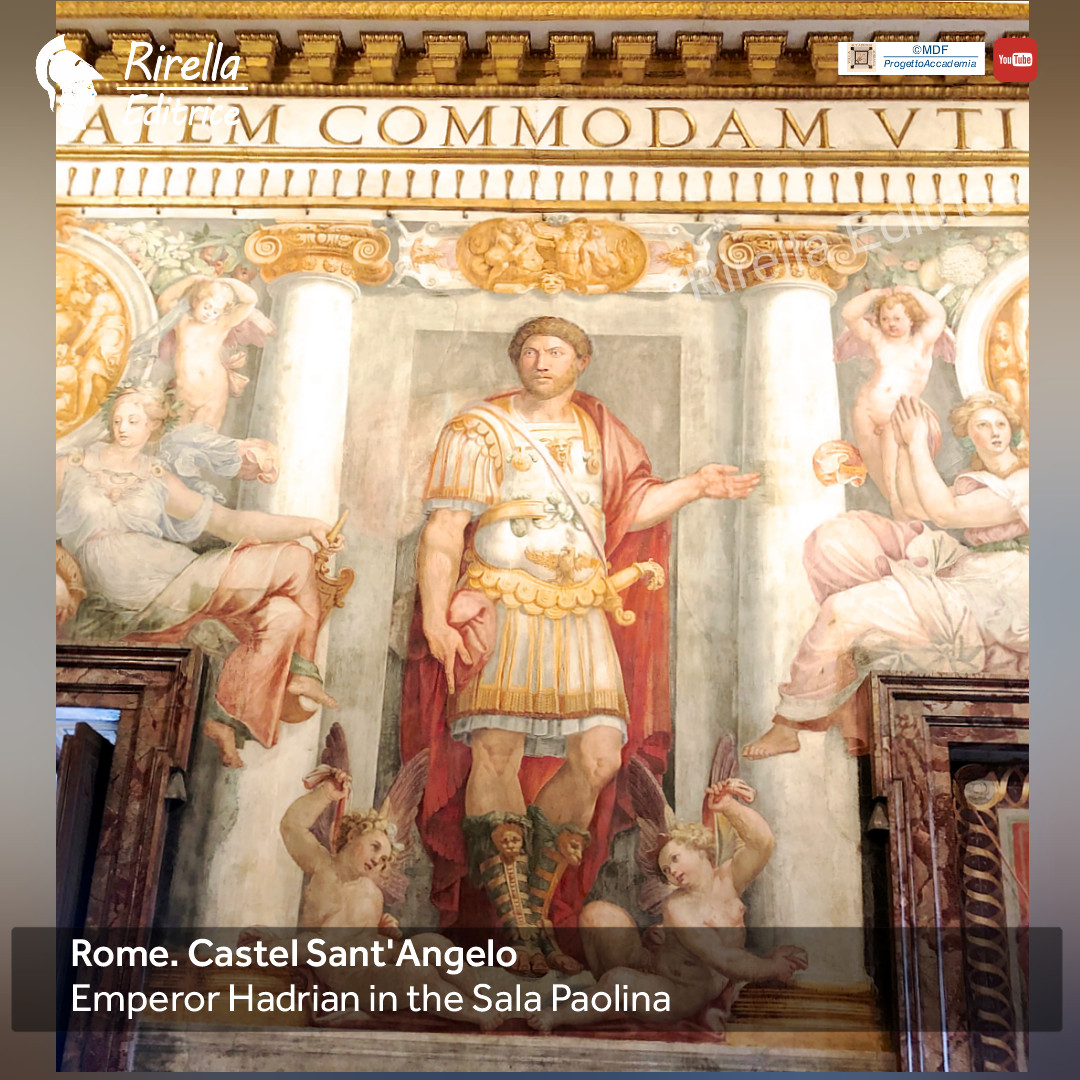
Its construction coincided with one of the Roman Empire's moments of greatest splendor and prosperity. Ancient sources tell us how and why it was built by Emperor Hadrian, who was a master of imperial propaganda and knew how to build the image of a new dynasty.
Hadrian presented himself as the ideal successor of Augustus, because like him he had put an end to wars of conquest, strengthened the empire's borders, and then launched an ambitious program of construction and restoration of public buildings.
Imitating Augustus's example, Hadrian decided to build a new imperial dynastic tomb during his lifetime, since the Mausoleum of Augustus lacked space for additional burials.
The Hall of the Burial Urns was revetted with precious marbles, which, like much of the decoration, has since disappeared.
Also the Campus Martius lacked space for a building of that size, therefore Hadrian chose the imperial grounds of the Horti Domitiae, on the opposite bank of the Tiber.
To reach them he built the Pons Aelius (Aelius Bridge), which, as we will see, was also a crossroads in the history of Rome.
During Late Antiquity and the Middle Ages, the Mausoleum of Hadrian suffered the same fate as many other monuments of Roman antiquity. It was plundered of its metals, marble, and all its precious materials.
Descriptions of ancient and Renaissance sources, archival research, excavation findings and on-site surveys have allowed us to at least partially reconstruct its ancient appearance, virtually stripping it of Renaissance additions.
Its tower-like shape and strategic location at one of the main entrances to Rome made it a key element in controlling the capital.
Thus, the Mausoleum was transformed into a fortress, which endured increasingly frequent and devastating sieges, such as that of the Goths in 537 AD.
The Gothic War (535–554) opposed Justinian's Eastern Empire and the Ostrogoths for the control of Italy. In 536 AD, General Belisarius occupied Rome, but the Gothic king Vitiges laid siege to it from February 537 to March 538.
As Procopius recounts, Belisarius routed them by throwing at them large fragments of ancient sculptures, smashed into pieces to use them as projectiles.
 From that moment on, the Mausoleum was stripped of all its precious marbles; the travertine, for example, was sold by the City and used to pave Rome's squares. Virtually only the inner core of the building remained standing, which would later be incorporated into the Renaissance fortifications.
The Castle
During the Renaissance, Castel Sant'Angelo underwent enormous transformations. It became both an impregnable fortress and a safe haven for the Popes, who called upon some of the greatest artists of the Renaissance to decorate their apartments. Thus, military architecture merged with art, because the great architects who worked on it were also outstanding artists.
But at the same time, the 16th century marked one of the most tragic events in the history of Rome and Italy: the Sack of the Landsknechts, the ferocious German mercenary infantry who attacked the city in 1527, commanded by Charles III of Bourbon on behalf of king Charles V of Spain.
The Castle played a key role in the event, because the Pope took refuge there with several thousand people. The Sack lasted seven months: the German mercenaries burned documents, destroyed works of art, and massacred the population with every kind of violence.
Finally, the Castle was "conquered" with the most classic of weapons: starvation. Having run out of supplies, Pope Clement VII was forced to a dishonorable surrender.
The second life of Castel Sant'Angelo is therefore closely tied to the history of Italian and Renaissance art, reflecting the continuity of power and its symbols between the Roman Empire and the Church, between Emperor Hadrian and the Archangel Michael, both symbolically linked to Light.
Hadrian was portrayed as Sol Invictus, riding the Chariot of the Sun, on a bronze sculpture which stood on top of the Temple of the Mausoleum.
Archangel Michael was the Archangel of Light, victorious over the darkness of Evil, who was placed atop the Tower that was built around the ancient Roman temple.
The book of Marina De Franceschini, «Castel Sant'Angelo. Mausoleum of Hadrian. Architecture & Light» (English edition) reconstructs the history of this extraordinary monument, where History, Art, and Archaeology intertwine with those of Rome.