One of the most mysterious and unknown sites of Hadrian's Villa, which has never been opened to the public, is the so-called Inferi (Underworld). We know about it from the famous passage in the Historia Augusta in which Publius Aelius Spartianus briefly describes Hadrian's Villa: «His Tiburtine villa was marvelously built, and he gave the most famous names of provinces and places to parts of it, calling them, for example, Lyceum, Academy, Prytaneum, Canopus, Poikile, and Tempe. And to leave nothing out, he even created the Inferi (Underworld)."
A puzzle that all scholars of Hadrian's Villa tried to solve, attempting to identify the various buildings. The first one, of course, was Pirro Ligorio, the great Renaissance scholar and antiquarian, who was one the first to excavate Hadrian's Villa, searching for treasures to decorate the Villa d'Este in Tivoli of his lord and patron, Hippolytus II d'Este.
Knowing that a statue of Hercules with the dog Cerberus, the mythical guardian of Hades, had been found there, he was the first to give the name Inferi to the building.
In the 17th century, Francesco Contini and then Giovan Battista Piranesi in the 18th century maintained the traditional name of «Inferi» but, but since they had a more rational and modern approach, they set aside the legends. Since the new very well ancient Roman architecture, they realized that the Grotto was a nymphaeum with a fountain, which simulated a grotto.
The Valley of the Inferi is difficult to find, even for those familiar with the Villa, because is inside a dense wood. It is long and narrow, sunk into the rock, and originally was a quarry for tuff and pozzolana, the building materials that were used for this and other villas in the area.
Hadrian transformed the valley into an evocative and mysterious nymphaeum, and since it has never been excavated, there is still much to discover. At the end of the valley, a Grotto can be glimpsed, which was partly dug into the tuff and partly built of masonry.
Inside the Grotto, two side doors lead to two subterranean corridors carved into the tuff, which, following a long circular path, emerge into the rocky sides of the Valley.
Both the Grotto and the corridors are lined with a special cocciopesto (opus signinum) a cement that imitates natural rock, while around the doors are tartari (fake stalactites) with traces of blue color.
They are illuminated by a series of round openings into the vaults (oculi), and a passageway connects them to the subterranean service road system and the Great Trapezium.
At the center of the Grotto's is a crack from which a waterfall once flowed, coming from a cistern that is still visible high up on the hill. The water was flowing into a series of basins which were drawn by Piranesi in his plan, but were never fully excavated, only explored during surveys.
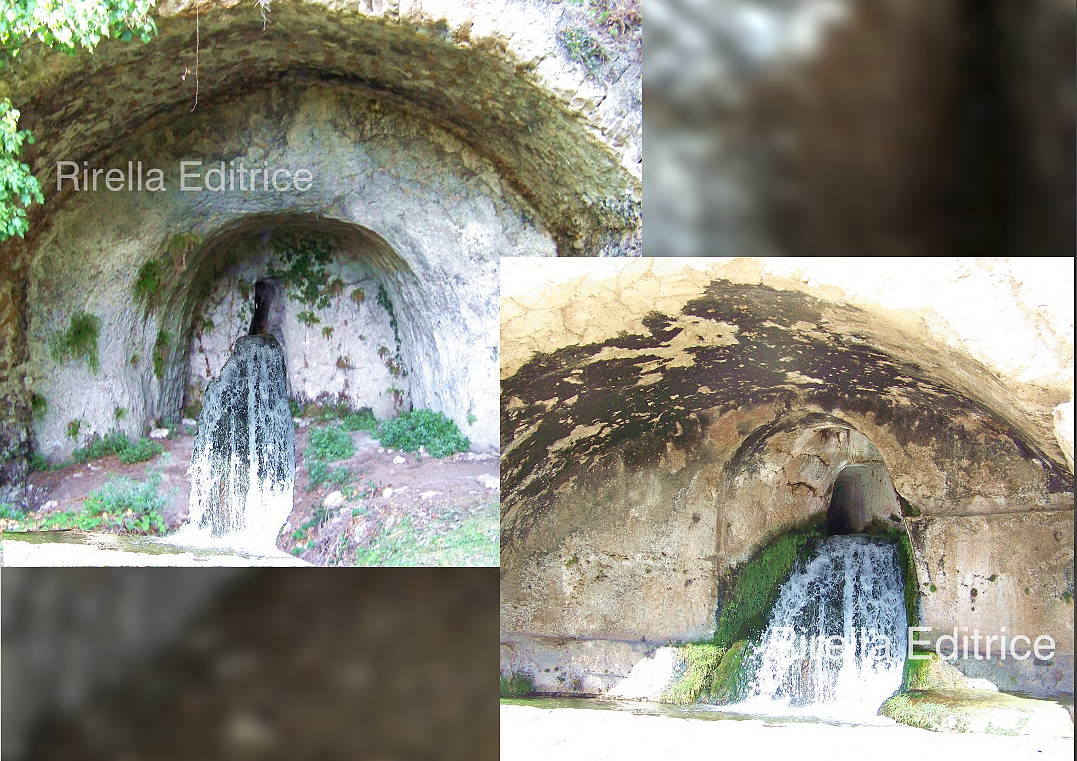
The fountain of the Inferi is very similar to an ancient Nymphaeum from the 4th century BC seen in Syracuse above the Greek Theater. It is an artificial Grotto carved into the rock, and even today water flows abundantly from an ancient tunnel. On the terrace above, we know from Cicero that there was a temple dedicated to Demeter and Kore. Perhaps the Inferi (Underworld), with its subterranean corridors, was also dedicated to that mystery cult.
The Grotto surely imitated the Grotto of Tiberius at Sperlonga, inside which after year 4 AD a spectacular summer triclinium was built. It was decorated with the extraordinary sculptures of Ulysses blinding Polifemus.
The Grotto of Sperlonga inspired other emperors afterwards, who created similar nymphaea-triclinia inside natural or artificial grottoes in their Villas. For example the villa of Claudius at Baiae (Naples) with the Nymphaeum of Punta Epitaffio. Or the Ninfeo Bergantino in the villa of Domitian at Albanum, today's Castel Gandolfo. And also the Canopus in Villa Adriana,