Part One: Birth and Military Career
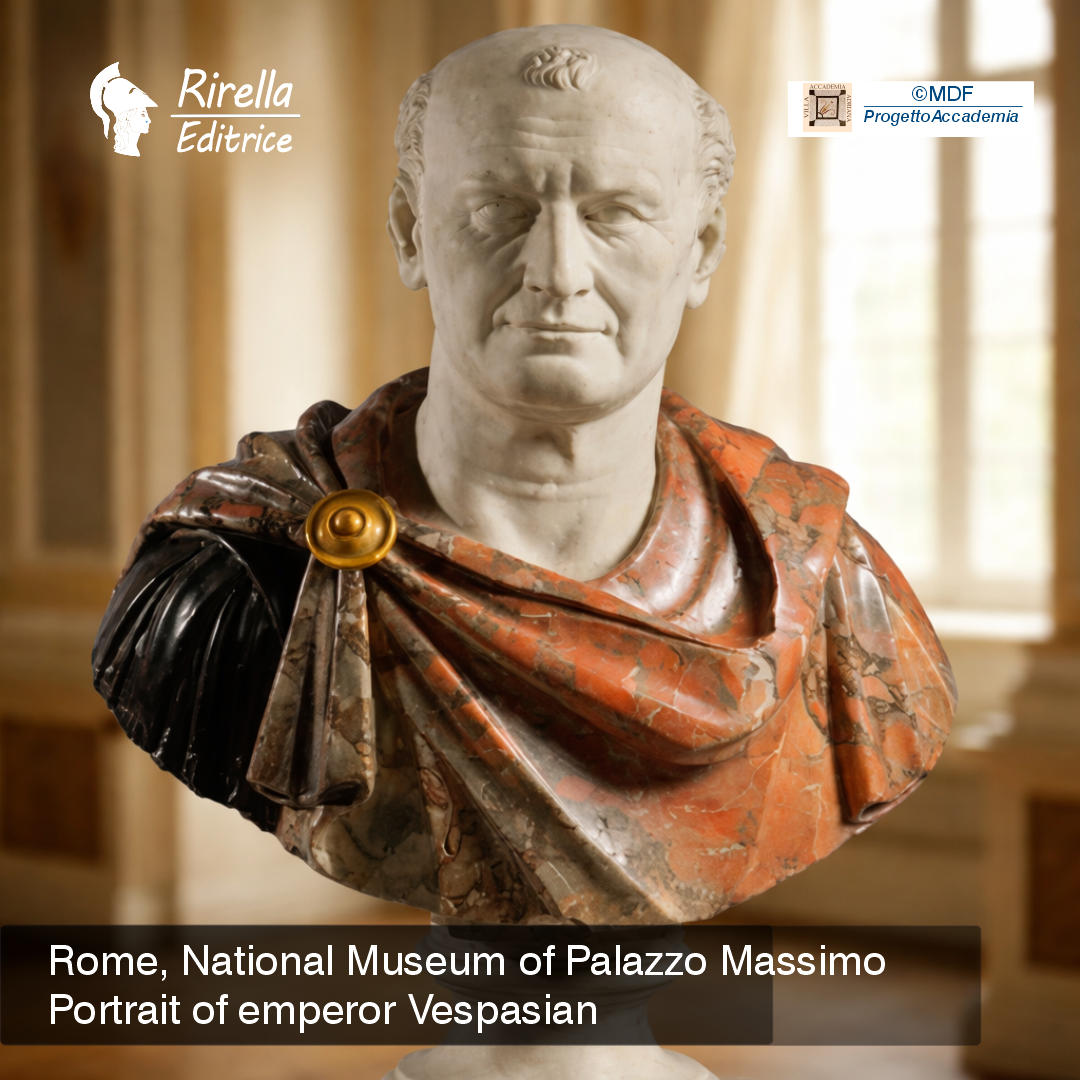
Vespasian (Titus Flavius Vespasianus) was born in Vicus Falacrinae near Rieti (Latium Italy) and belonged to the Italian municipal bourgeoisie, thus having nothing to do with the senatorial aristocracy. His father lived for a long time in Aventicum, the capital of Roman Helvetia, where he was a tax collector. Upon becoming emperor, Vespasian built new walls, temples, and public buildings in that very city, where his son Titus had lived with his grandfather as a child. Vespasian immediately distinguished himself for his military prowess, in campaigns in Thrace, Germany, and Britain; he served as proconsul in Africa, and resolutely quelled the Judean uprising during the Jewish War that began in 66 AD. Under Nero, the war was continued by him and concluded in 70 AD by his son Titus with the conquest and destruction of Jerusalem, as we know from Flavius Josephus.
The Arch of Titus was built by him to commemorate that victory, and the Colosseum was built thanks to the immense spoils that he conquered. Vespasian promoted public works, which we will discuss later.
Upon becoming emperor, Vespasian sought to prevent rebellions and mutinies in the army, restoring discipline and seeking new funding to maintain its efficiency. Given the chronic shortage of new recruits, he encouraged the enlistment of auxiliary troops.
When Nero died in 69 AD, he left no heirs, and the turbulent "year of the three emperors" began: Galba, Otho, and Vitellius, who were eventually joined by Vespasian. Galba and Otho lasted only a few months in office; Vitellius was recognized by the Senate, but at the same time Vespasian was acclaimed emperor by his soldiers in July 69 AD while he was in Africa, where he remained awaiting developments. The Senate, now devoid of all power, recognized Vespasian's appointment only on December 22, 69 AD, after the death of Vitellius.
With Nero's death, the Julio-Claudian dynasty had died out, and the system of power established by Augustus, based on the prestige and authority of the princeps – in a disguised monarchy that maintained formal respect for the Senate and the republican institutions – had entered into crisis. But the power struggle between the senatorial aristocracy and the various imperial dynasties, marked the entire history of Rome, up until Diocletian, and certainly did not end.
The Senate was outraged because, with Vespasian, for the first time an emperor had been appointed outside Italy and had not been chosen by the senators. Suetonius and Tacitus (who, being senators, are not impartial) considered Vespasian a parvenu, belonging to an "obscure people" and called him "unexpected prince," emphasizing that he possessed neither the authority nor the majesty of Augustus.
They pretended not to know that the era of the Julio-Claudian dynasty, which proclaimed itself superior to others and therefore the only one predestined to have the right to imperial power (like the fairy-tale princes with "blue blood"), was over.
Vespasian knew that the principate needed to be re-founded on new foundations; with a skillful use of propaganda, he made it a high public office, accessible even to men born and raised in provinces, like Trajan.
He returned to Roman traditions by eliminating the the oriental deification of the emperor, rejecting divine honors, like Tiberius. As Suetonius reports, even in the last days of his life he defended the dignity of his office and worked hard, because in his opinion "an emperor must die standing on his feet".