The Latin Library and the Greek Library are one near the other, and were built on the Upper Terrace of the Libraries, which was decorated with a long fountain with octagons at each end.
It was accessed from the Lower Terrace of the Libraries, via two staircases built into the large retaining wall that supported the terrace itself.
The Latin Library had the same structure as the Greek Library, with two large quadrangular rooms covered by cross vaults, plus additional rooms.
Two steps led to the first large hall, BL1, which had three rectangular niches. In the central niche, a large window provided an axial view of the second hall, BL3, which has an apse with a pedestal for a statue that is lost, and remains of a fresco in the half-dome.
To the east of the two large halls are several well-preserved rooms with their original barrel vaults. Their irregular shape linked the orientation of the Upper Terrace of the Libraries with that of the Courtyard of the Libraries, which is completely different.
On the west side of the building, two doors gave access to the portico ABC that connected the two Libraries.
The Latin Library was part of the noble buildings where the emperor lived, as evidenced by its precious decoration: opus sectile floors with colored marbles, marble wall coverings of which nothing remains. This is also confirmed by the presence of a two-seater latrine (for privacy), while in the secondary buildings for the staff and the court or in those for slaves, the latrines always had multiple seats.
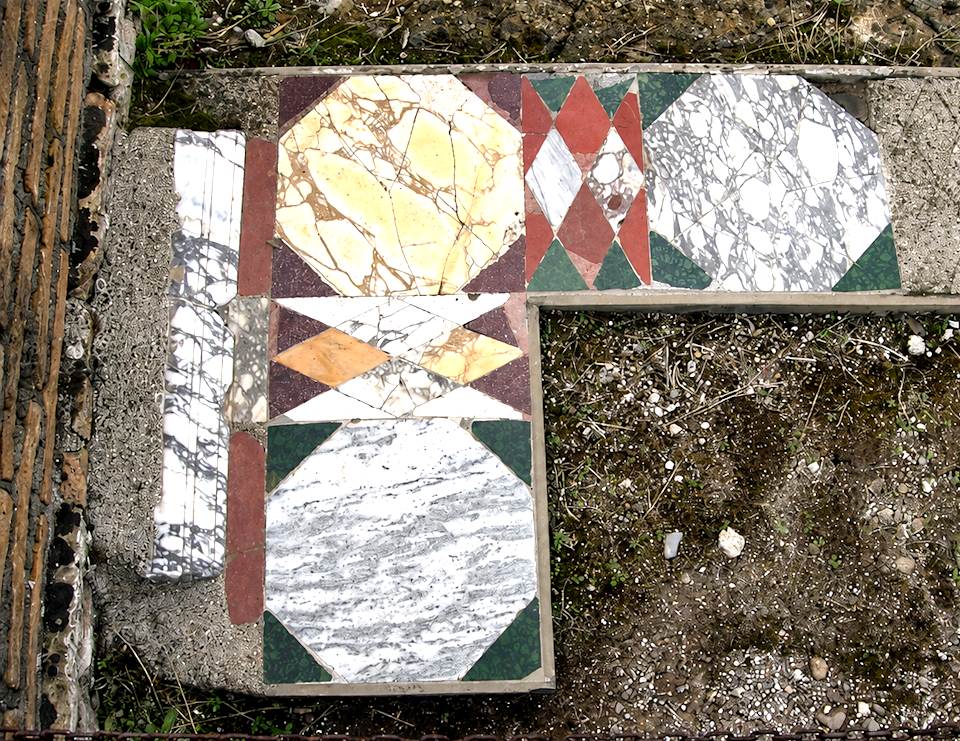 The name Latin Library is obviously fictitious. In the 16th century, the two buildings were interpreted as Libraries by Pirro Ligorio due to the rectangular niches seen in the main rooms of both buildings.
In his opinion, they could have contained papyrus and manuscripts; and since there were two, he called them "Greek" and "Latin" to distinguish them.
In reality, there are no traces of shelving in the niches of both Libraries, just as in the Hall of the Philosophers, which was not a library as many thought (see our blog).
According to Filippo Coarelli, the two Libraries could have been summer triclinia because they face north and therefore were cool and ventilated. However, there is no room for a masonry triclinium (stibadium) like the one seen in the Canopus and in all the triclinia identified in the Villa. According to Kähler, the Libraries resemble the turres of Vitruvian villas, a more plausible hypothesis.
It is likely that the two Libraries were two monumental atriums decorated with statues, a kind of Propylaea; they provided access to the private quarters of the Villa, which included the Imperial Palace and other buildings, as we explain on our website in the section dedicated to the Imperial Palace Area.