THE VILLA OF THE VOLUSII AT FIANO ROMANO (Rome)
There is no true ownership of a territory unless it is inhabited. From the 3rd to the 2nd century BC, villas were a key element of Roman civilization; together with cities, roads, and centuriations, they enabled widespread settlement, first in Italy, then throughout the Mediterranean and Europe, following common rules and patterns.
The term «villa» is quite generic: today and also in Roman times, it is used for different buildings located outside of the cities, on the sea or in the countryside. Initially, they were rustic villas, small farms entirely focused on agricultural production. Later, a residential section with good decorations was added to the productive part, intended for the owner, the dominus.
At the beginning of the empire, the first luxury villas appeared, followed in the height of the empire by grandiose monumental villas, sometimes located within vast estates. Many of them underwent multiple construction phases, which were expanded and modified over the centuries.
The first luxury villas had a residential and a productive part, like the older villa-farms, but differed in their large size and luxury. They belonged to members of the aristocracy, important and wealthy figures, and were initially suburban villas, located a short distance from the city and easily accessible.
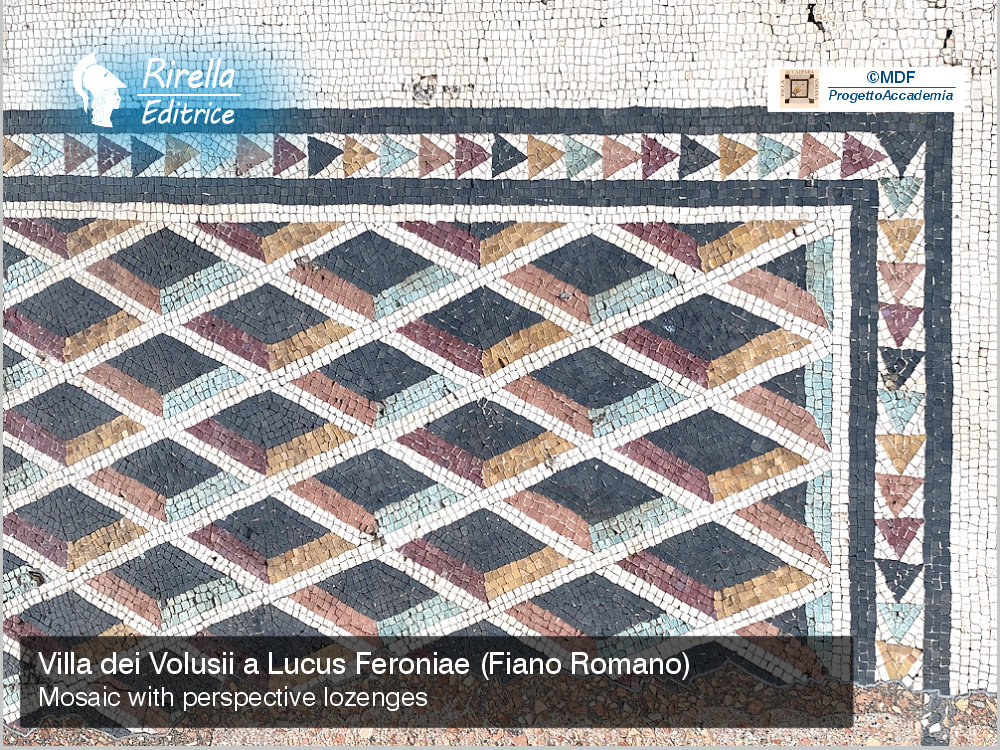
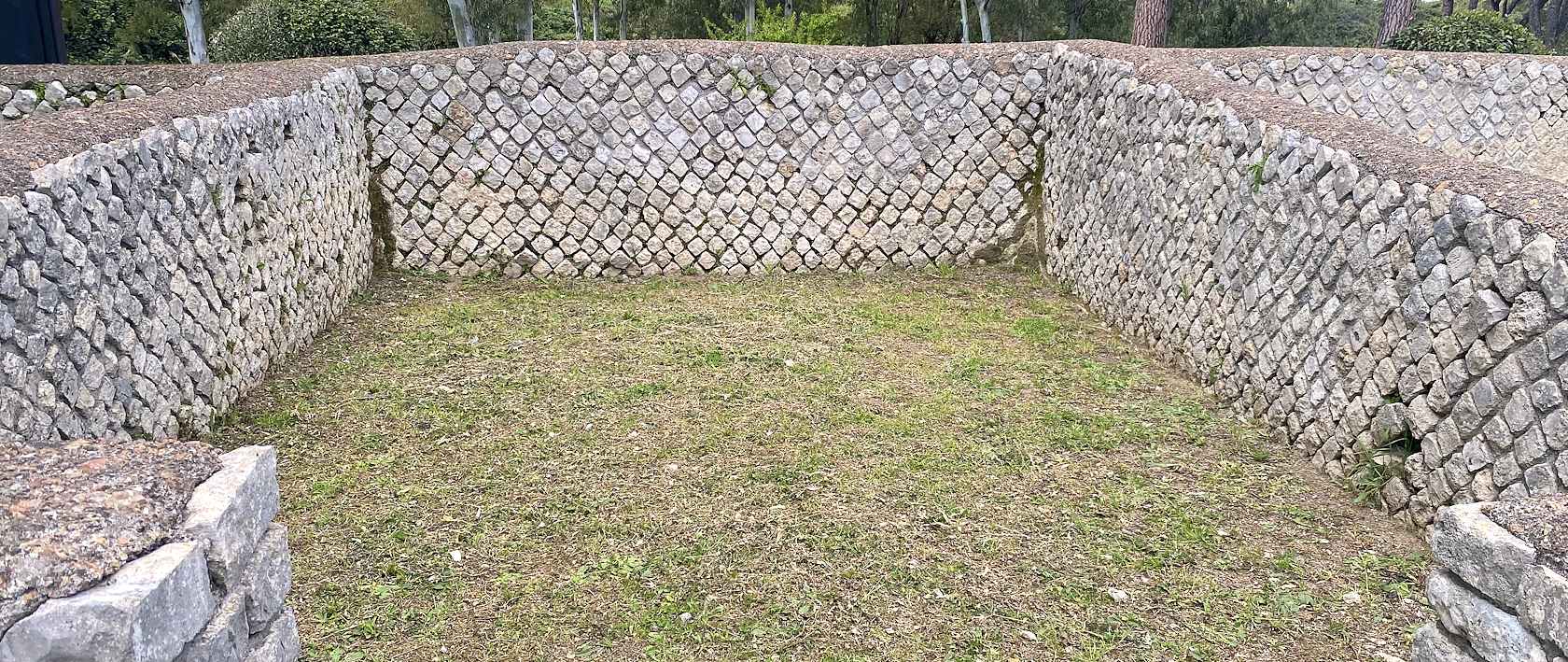
The Villa of the Volusii at Lucus Feroniae (present-day Fiano Romano), on the Via Tiberina, is an example of a luxury suburban villa, which had several phases. Built in the mid-1st century BC with opus incertum walls, it was enlarged at the time of the Augustus and modified in the 2nd century AD, during the reigns of Trajan or Hadrian. In the 1960s, it was partially destroyed by the construction of the Highway, the Autostrada del Sole, which leveled the area where the atrium once stood.
During the Augustan era (late 1st century AD), the oldest villa was enlarged and redecorated. The residential section had an atrium (now destroyed) and an inner peristyle with rooms decorated with precious polychrome mosaics, which showed the owners' wealth.
The Volusii were a prestigious senatorial family, related to Emperor Tiberius. Among its members were the consuls Lucius Volusius Saturninus and Quintus Volusius Saturninus, who had been proconsul of Asia under Augustus, and was the legate of Tiberius in Dalmatia.
Next to the residential section was a productive area with a press (torcularium) tanks for collecting and decanting the wine, and a storehouse (cella vinaria) with dolia. There were two different plants, one of the Republican era and the other from the Imperial era.
Also during the Augustan era, a vast rectangular peristyle was added, surrounded by small rooms with beaten earth floors, which must have been used as warehouses for storing agricultural products.
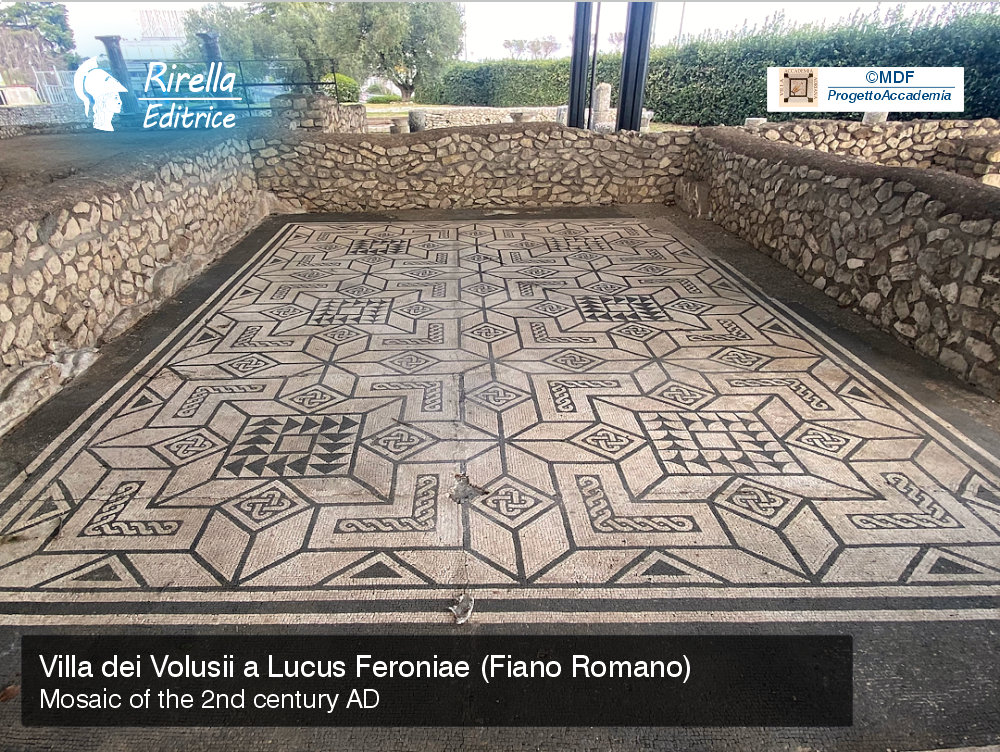
The only room with a mosaic floor was the Lararium, which was larger than the other ones.
Inside were the statues of the family's ancestors, now preserved in the Lucus Feroniae Antiquarium, along with commemorative inscriptions dedicated to the two consuls. Terracotta slabs (Campana) with Dionysian depictions indicating wine production were also found.
It is likely that the large peristyle was used for the nundinae, the weekly or monthly market fairs mentioned in ancient sources. It was a private market similar to the public markets (Macella) like those in Pozzuoli or Ostia, which had a portico surrounded by rows of shops and a central shrine with the statues of the emperors, dedicated to the imperial cult.
The Lararium of the Villa dei Volusii had a similar function, celebrating the family's glories and social rank and was dedicated to ancestor worship.
The oldest wing of the villa was therefore reserved for vacation and relax, or otium. The new wing, added at the same time, served instead for business, or negotium: the sale of its products was a reliable source of income that attracted local customers, saving on transportation costs to Rome.
In the 2nd century AD, during the reigns of Trajan and Hadrian, the villa was expanded and redecorated with new black and white mosaic floors featuring floral designs. The Villa was located near the via Tiberina and also not far away from the Tiber river and from Lucus Feroniae which was a very important town in the area and was excavated few year ago.
Bibliografia: Marina De Franceschini. Ville dell'Agro Romano. Roma 2005, scheda n. 99, pp. 274-285.
with previous bibliography.