Why did Hadrian build his grandiose villa in Tivoli? Because it was a fashionable place, not far from Rome, where Roman aristocrats built their leisure villas since the time of Augustus.
He chose Tivoli for the spectacular Aniene waterfalls, for the abundance of water that several aqueducts brought to Rome, and, last but not least, for the abundance of building materials on the spot: tuff and pozzolana.
Which was the purpose of Hadrian's Villa? Obviously, to show the emperor's wealth and magnificence: only an emperor could afford to build what cannot even be called a palace and defies classification.
We can define it as a large stately estate, which had a private section, reserved for the Emperor and protected by a series of obligatory passages that were architectural security filters.
Hadrian's stay at Hadrian's Villa was brief, but it was home to a large court and a population of slaves and servants, the number of which can be inferred from the size of the Hundred Chambers and the Praetorium Substructures where they lived.
Alongside the private area reserved for the emperor and his court, Hadrian's Villa naturally had a public area, designed to accommodate a large number of people for audiences or events, as can be seen from the size of the large porticoed garden of the Poecile.
But the most important function was to receive illustrious guests in grand style, as only a cultured and refined emperor like him could do. And this took place in one of the Villa's iconic buildings: the Canopus.
Imagine being invited to an official banquet by the Emperor, and to follow the route reserved for the most important guests. They reached the Villa along a paved avenue, the Paved Driveway, skirting the great watchtower of the Hundred Chambers, through a pillared entrance of which very little remains.
The carriages traveled along its entire length until they reached the foot of a large, monumental staircase, flanked by niches for statues and fountains, which went up to the Vestibule, the monumental entrance reserved for the Canopus's guests, separate from all the rest.
There began a surprising path that introduced guests to the incredible artificial landscape created by the emperor to amaze them. They crossed a large portico decorated with statues until they reached a corridor that led to the Canopus.
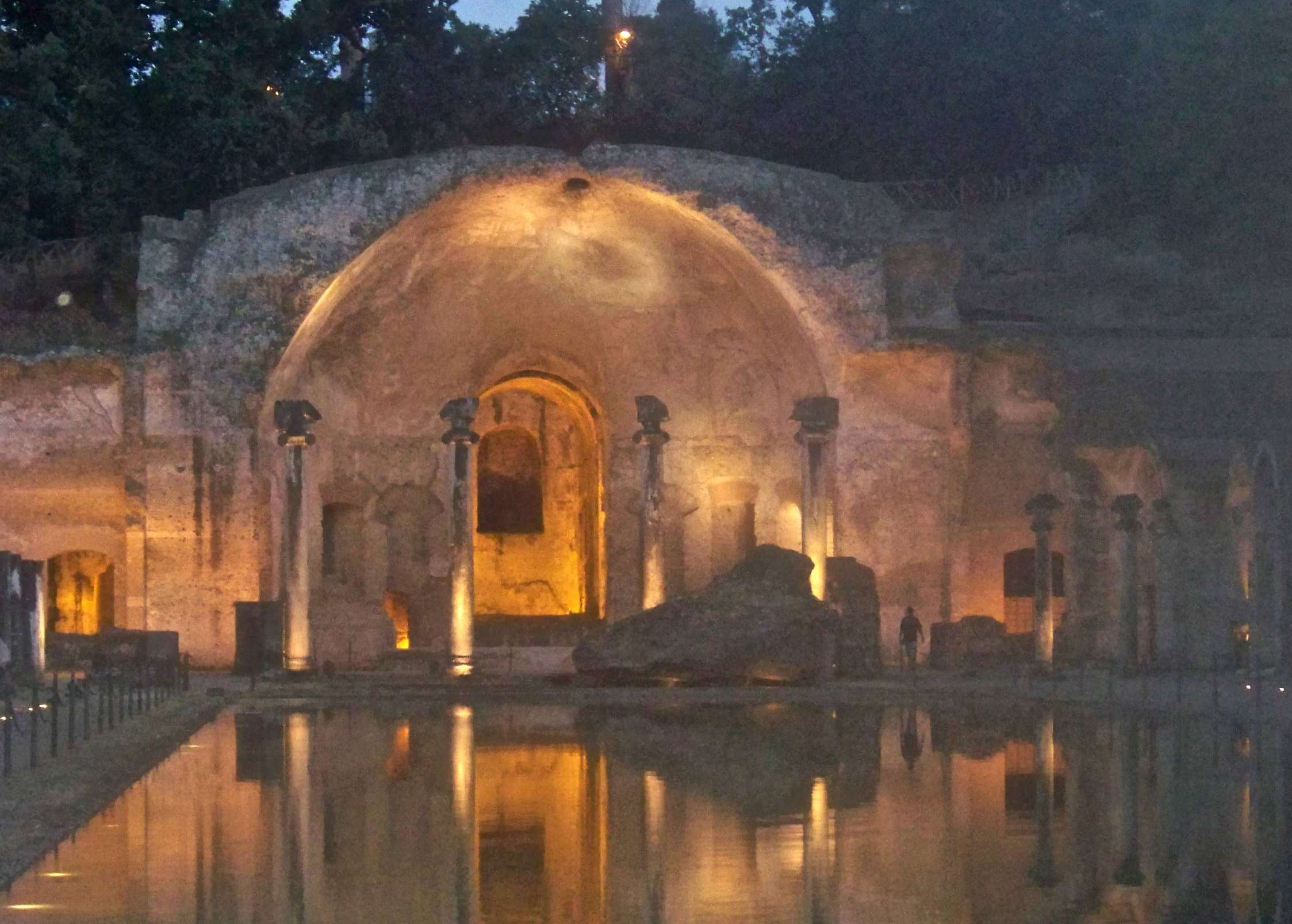
From afar, the columns and statues could be glimpsed, arranged along the edges of a very long water basin, the Euripus, at the end of which Hadrian built the so-called Serapeum, a sort of artificial grotto with a segmented half dome, where the water triumphed in a spectacular way.
The Serapeum was actually a magnificent summer triclinium, with a stibadium, a masonry triclinium bed where guests could recline on soft cushions and were surrounded by small waterfalls that mitigated the summer heat.
The water came from a small aqueduct on arches located behind the large half-dome, and descended through special pipes into four niches with small stairs, before collecting in canals that ran behind and in front of the stibadium itself, and from there flowed into the Euripus.
In front of the triclinium there was a small stage where actors, dancers, and musicians entertained guests with performances and concerts, songs, dances, and music. The large dome served as a sounding board; the acoustics were perfect.
The stibadium could accommodate dozens of people, but Hadrian certainly did not sit among them, also for safety reasons. His private and privileged place was the so-called Antrum, a sort of artificial cave extending into the hill and partially covered by a barrel vault. There, in a commanding position, comparable to that of a royal box in a theater for acoustics and view, Emperor Hadrian sat, along with a handful of other important guests.
There, too, water reigned supreme: the imperial box was a kind of bridge suspended over a pool of water that overflowed and cascaded into the same canal surrounding the stibadium. It was partially covered by a barrel vault, so that the sun's rays could shine on the emperor during the day. If summer banquets were held in the evening, al fresco, the flames of torches reflected in the pool in front.
Hadrian thus provided a spectacle in every sense: with architecture, the colored marble decoration, sculptures, and water works. And then there was a whole refined staging with the food, the precious pottery, which we can only imagine, but today is easier to reconstruct.