Part Three and Conclusions
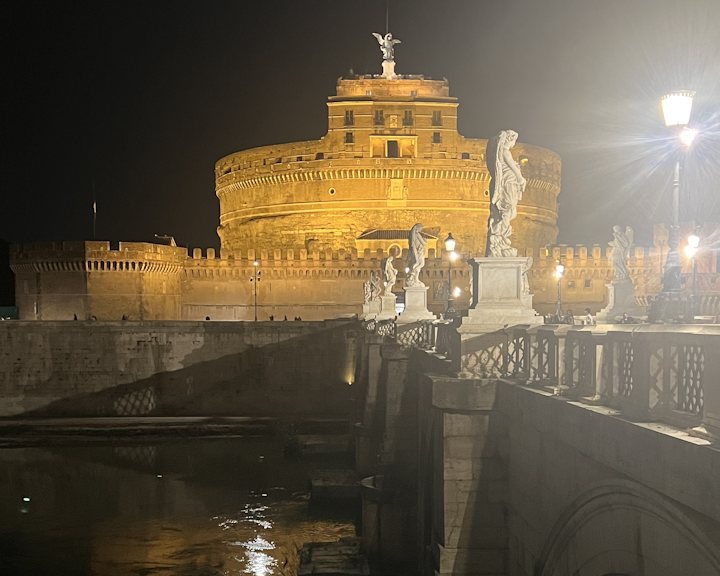
THE MAUSOLEUM OF HADRIAN – CASTEL SANT'ANGELO
It is one of the grandest monuments of ancient Rome, originally an imperial Mausoleum and later transformed into an impregnable fortress during the Middle Ages.
Like all great Roman monuments, Hadrian's Mausoleum was designed and built to last forever, and indeed it has defied the millennia, overcoming natural and human disasters such as floods, earthquakes, wars, and looting.
Thanks to its foundations, over seven meters deep, and the expert shaping of the riverbed, the Mausoleum has withstood the recurring floods of the Tiber.
Thanks to its mighty walls, it was never conquered during the sieges of the Visigoths, Vandals, and Goths in 410, 455, and 537 AD, nor during the Sack of Rome by the Landsknechts in 1527, when the Pope and his court took refuge there for seven months.
 The thousand-year history of the Mausoleum and its hidden symbolic meaning are recounted and revealed in Marina De Franceschini's book, «Castel Sant'Angelo. Mausoleum of Hadrian. Architecture & Light» (English edition also). Thanks to discoveries in archaeoastronomy, she offers a new and unprecedented reconstruction of the Mausoleum's ancient appearance, virtually stripping it of all medieval and modern additions.
The Mausoleum once had a rich and refined decoration, of which only a few splendid fragments remain, exhibited in the magnificent Antiquarium. Over the centuries, its columns and capitals, were stolen; they were made of precious marbles from throughout the ancient world. The large blocks of travertine and peperino that once clad it were used to pave the streets and squares of Rome.
At the center of the Mausoleum is the Sepulchral Hall (or Hall of the Burial Urns), in an unusually elevated position, built with blocks of travertine and tuff. It was completely clad in precious marbles, but only a small fragment of pavonazzetto marble remains; the floor was made of white Luni marble (Carrara marble).
The Hall of the Burial Urns has a Greek cross plan, with three niches on the east, west, and north sides, which housed the sarcophagi of emperor Hadrian, his wife Sabina, and likely Aelius Caesar, the designated heir to the throne who predeceased them.
A red porphyry sarcophagus was discovered in the Hall of the Burial Urns. It was reused for the tomb of emperor Otto II (973-983) of the Holy Roman Empire and was destroyed in a fire. Only the lid survives, which was transformed into a baptismal font by Carlo Fontana in the 17th century and is now in St. Peter's Basilica.
Unfortunately, the Hall of the Burial Urns has now become a passageway leading to the upper floors of the Castle, where the magnificent papal apartments, decorated by some of the greatest artists of the Renaissance, are located.
Visitors rush past, failing to understand that this was originally the most sacred and important place in the Mausoleum, linked to a complex symbolism explained in our book.
Conclusions
What did the Mausoleum, the Pantheon, and Hadrian's Villa have in common? That they were all designed and built to create special illuminations.In the Mausoleum of Hadrian the sun enters through the two window-tunnels opening in the vault, creating rectangles of light in each of the three niches, including the central north one, which is now hidden by Valadier's modern walkway.
And this happens only in the days of the Summer Solstice, (June 21st) as we explain in our book «Castel Sant'Angelo. Mausoleum of Hadrian. Architecture & Light» (English edition).
At Villa Adriana the rays of the Sun enter from the door and from the "light conduit" of Roccabruna, creating a Blade of Light in the days of the Summer Solstice.
Both in Roccabruna and in the Accademia there were illuminations at sunrise in the days of Winter Solstice and at sunset in the days of the Summer Solstice, which had e precise symbolic meaning, as explained in our book «Villa Adriana. Architettura Celeste. I segreti dei solstizi». (Italian edition only)
And finally in the Pantheon there are illuminations in the days of the Equinox, of the Solstices and most of all the Arc of Light that can be seen just for six days every year, as we explain in our book «Pantheon. Architecture & Light» (English edition)
Therefore this is not a coincidente but the outcome of a precise project created 1900 years ago in those magnificent buildings, to show that emperor Hadrian, who built them, was so powerful as to command even the course of the Sun; and in fact he was portrayed as Sol Invictus driving the Quadriga of the Sun on top of his Mausoleum.